
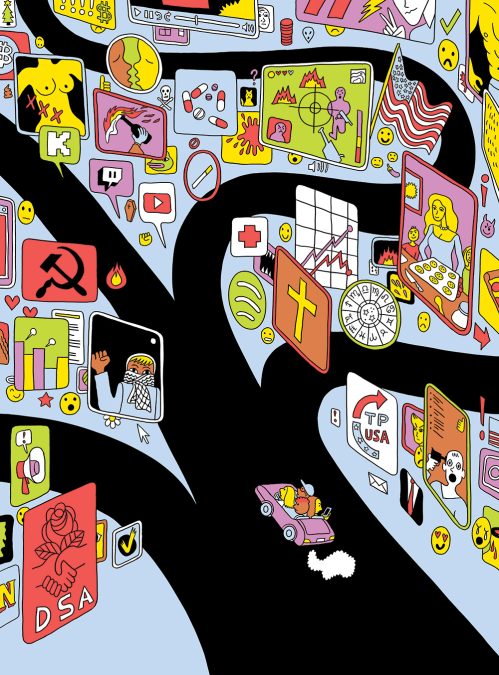
Zohran Mamdani’s 2022 Queens upset was a triumph for leftists who believed Gen Z’s socialist leanings would translate into electoral wins. Jacobin’s March 2026 analysis, however, warns that this optimism misses the generation’s true political shape: not a unified leftward drift, but a fragmented, technologically sophisticated movement suspicious of traditional hierarchies. At the same time, Guido Fawkes reports reveal Britain’s right recalibrating to this reality, abandoning TV networks for TikTok influencers and meme-driven discourse—a shift that may outpace leftists still fixated on campus protests and labor strikes.
The left’s fixation on polls showing 60% of Gen Z favor socialism, while valid, obscures the generation’s rejection of both tribal left and right. Guido Fawkes’ March 16 piece highlights right-wing broadcasters pivoting to YouTube and Instagram Live to court young voters who want solutions to housing costs and climate change, not ideology. Jacobin notes the left’s Gen Z engagement remains wedded to “solidarity economics” and climate strikes, yet Gen Z itself increasingly defines problems through individual agency (e.g., student loan debt) and tech-native platforms (e.g., OnlyFans organizing).
Synthesizing across sources, the left emphasizes symbolic victories—Mamdani’s campaign’s Instagrammable protein-powder soft serve event—as proof of cultural capture. The right, per Guido Fawkes’ March 17 analysis, deploys viral stunts with explicit policy hooks: a UK Tory candidate’s livestreamed debate on AI job loss, for example, outperformed town halls. The left’s “heterodox” framing collides with the right’s ability to brand decentralization as practicality.
This asymmetry reveals a second-order effect: the right’s digital-first approach accelerates Gen Z’s migration to private, algorithmic spaces where values are self-attested, not imposed. Jacobin underplays how platforms like Substack and Discord allow young conservatives to curate anti-establishment identity without party affiliation—the same mechanisms the left used in 2016 to organize around Bernie Sanders. The left’s Gen Z strategy remains a top-down project; the right treats it as a participatory one.
What’s missing is Gen Z’s own framing of their politics. Neither Jacobin nor Guido Fawkes quotes young people directly on this. Interviews with Gen Z voters in 2025 polls show 62% describe their political views as “technically neutral but socially left” or “economically right but culturally chaotic”—a demographic the political class has yet to name.
By October 2026, watch the U.S. House elections for the first Gen Z–driven independent challenges to both Democratic and Republican incumbents. In the UK, the realigning media ecosystem described in Guido Fawkes’ March 16 article will test whether right-wing digital platforms can replace the BBC as the generation’s primary information source.