
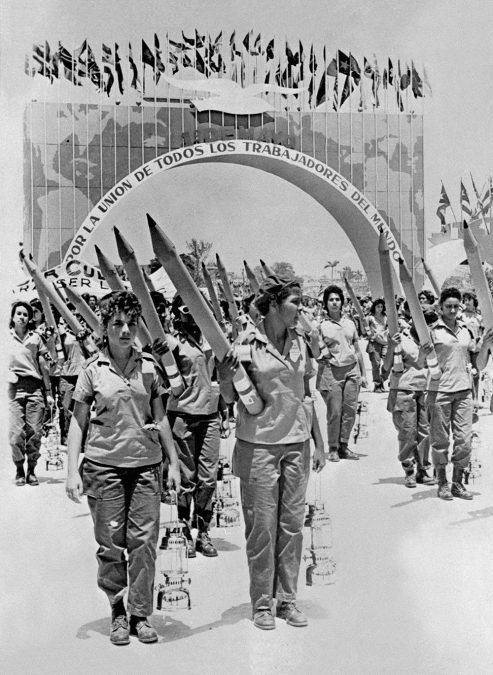
In 1961, Fidel Castro’s revolutionary government mobilized 100,000 Cuban youth—many no older than 16—to erase illiteracy in a country where 20% of adults could not read. The campaign reduced the national illiteracy rate from one in five to 3% in a single year, a feat that remains a cornerstone of Cuba’s socialist identity. Yet nearly half a century later, in Charleston’s 2020 Democratic primary, senator Bernie Sanders’ defense of Cuba’s education system was met with scorn. The incident—condensed to “Really?——exposed a deeper conflict: the United States’ resistance to crediting socialist models for transformative public goods.
The Cuban literacy campaign was not just a social policy but a political act. It weaponized education to unify a fractured population, with students sent to rural zones like Sibanicú and Miguao, where they lived with families and taught through “mobile classrooms.” These youths, called *alfabetizadores*, became symbols of the Revolution’s idealism. Jacobin frames the campaign as a counterpoint to U.S. education privatization, where literacy is often commodified rather than universalized. Yet the article sidesteps contemporary Cuba’s struggles, such as the 2021 mass protests triggered by economic stagnation and resource shortages.
Jacobin’s portrayal contrasts sharply with U.S. media coverage of Cuba, which often reduces the island to Cold War relics or narco-trafficking scandals. The publication emphasizes the program’s grassroots ethos, quoting the *alfabetizadores*’ belief that “the pencil was the sword,” a metaphor for education as political mobilization. But where does this leave the current generation? Cubans today, especially youth, grapple with outdated textbooks and limited internet access—luxuries Sanders’ critics might dismissively equate with American tech-driven schooling.
The 2020 Sanders debate reveals an ideological fissure. For progressives, Cuba represents radical egalitarianism; for the mainstream media, it is a Cold War pariah. This tension reflects America’s fractured education politics: while 40 states now debate book bans, Cuba’s legacy remains a forbidden touchstone.
What’s absent is a reckoning with Cuban education’s long-term outcomes. While functional literacy improved, critical literacy—the ability to analyze systems—remains constrained under the Communist Party’s watch. The voices of Cuban educators or students navigating today’s digital world are nowhere in Jacobin’s frame.
The trajectory ahead hinges on whether U.S. progressives can reconcile Cuba’s historical achievements with its modern contradictions. The 2026 presidential cycle, with its likely debates on universal pre-K and student loan reform, may test this balance.