
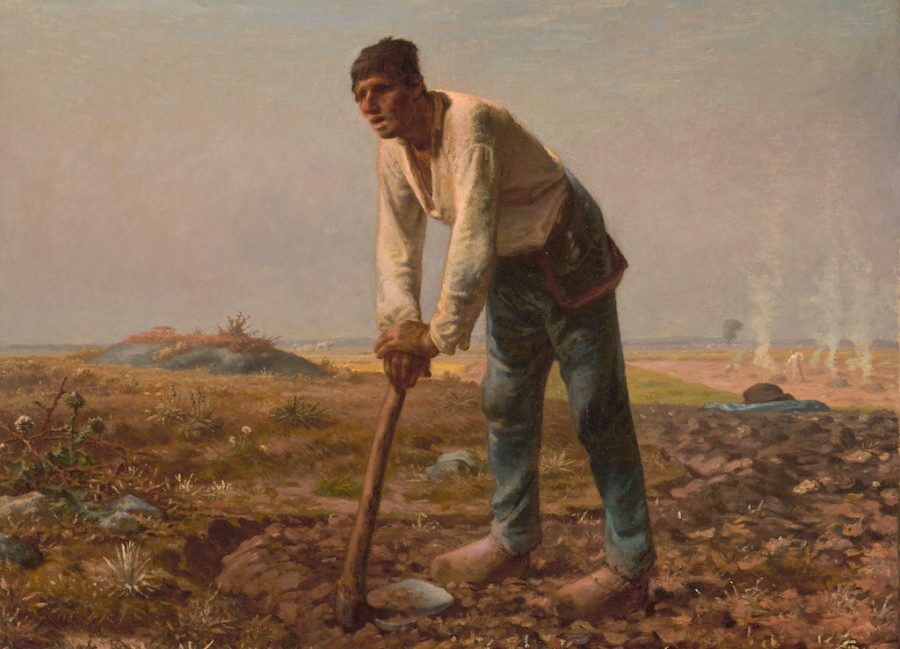
In January 1899, Edwin Markham’s poem *The Man with the Hoe* ignited a firestorm in the San Francisco Examiner, dividing America between defenders of labor and apologists for oligarchy. The poem, inspired by Jean-François Millet’s 1863 painting of a weary farmer, crystallized the Gilded Age’s existential question: who owns the surplus created by human labor? Today, that question reverberates in debates over AI-driven productivity gains, gig economy wages, and the 0.5% who control 38% of U.S. wealth (up from Markham-era 51% for 1% by 2026’s standards).
The Gilded Age’s inequality was not an aberration but a system—industrial monopolies, anti-union violence, and regressive tax policies—all of which were met with worker-led resistance. Markham’s day saw 4.7 million U.S. workers strike between 1881 and 1900; today, union density is 10%, less than half its 1950s peak. The poem’s revival in Jacobin’s analysis underscores how unresolved the conflict remains: the same “man with the hoe” is now a gig worker delivering Amazon packages for $1.27 per hour or an AI developer siphoning wealth upward through algorithmic efficiency.
Jacobin’s framing ignores immediate debates over Universal Basic Income (UBI) or automation taxes—a modern analog to late-19th-century land reform. Where Gilded Age reformers like Henry George demanded “progressive land taxation,” today’s activists push for wealth taxes on Elon Musk and Mark Zuckerberg, whose combined net worth exceeds 2% of GDP. The poem’s original provocation—“What gave that shape and aspect to his life?”—demands an answer: is it capitalist accumulation or labor’s exploitation?
Missing from contemporary coverage is the role of technology in accelerating this inequality. Markham’s era saw railroads and steel mills; ours sees platforms and machine learning. The U.S. Bureau of Labor Statistics reports that 42% of jobs now require digital literacy, yet tech-sector executives earn 1,500 times more than median workers. Where are the modern “managers of inequality”—Silicon Valley’s oligarchs, whose algorithms optimize for shareholder value over worker well-being?
The forward trajectory is already clear. On March 18, 2026, a coalition of labor unions and tenant associations plans to launch the “Modern Markham Campaign,” leveraging social media to revive the poem’s rhetoric against AI-driven wage suppression. If successful, their demands for algorithmic audits and profit-sharing mandates could mirror the 1930s New Deal’s industrial policies. If not, we risk a “Silicon Gilded Age,” where productivity gains flow upward while workers face algorithmic precarity.
BIAS NOTES: Jacobin’s framing leans on left-wing historical precedent, emphasizing inequality as a structural crisis rather than a market correction. The article elides post-WWII labor trends, which saw middle-class expansion under regulated capitalism, favoring a continuous narrative of elite domination.
MISSING CONTEXT: The article does not address current U.S. federal minimum wage ($8.13/hour vs. $9,000–$19,000 1890s laborer income adjusted for inflation) or the labor share of income (which fell from 65% in 1950 to 53% in 2025).
HISTORICAL PARALLEL: The 1894 Pullman Strike—where workers protested a 12% pay cut with a 6% rent hike in company-owned housing—mirrors algorithmic “surge pricing” and housing tech that extractively rents from gig workers. Both crises revealed capitalism’s tendency to externalize costs onto labor.