
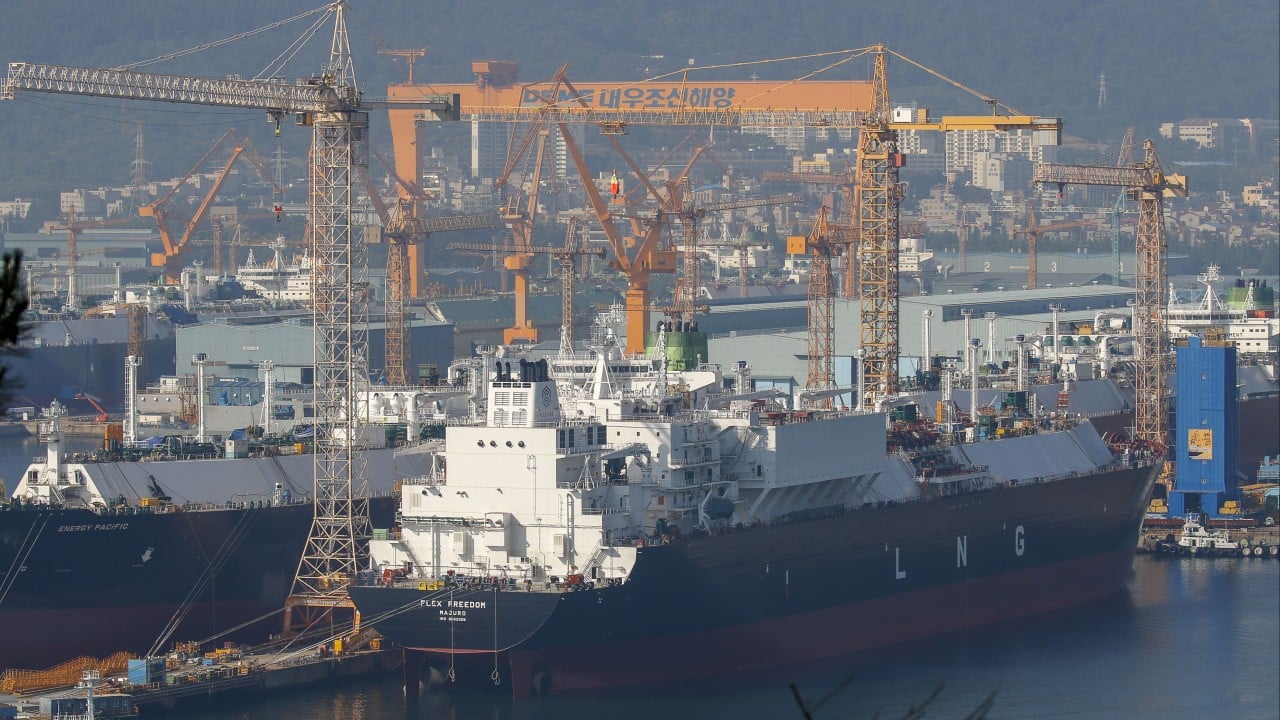
Japan’s Ministry of Land, Infrastructure, Transport and Tourism convened a working group in March 2026 to revive dormant LNG carrier construction by 2025, the first in over six years, as the U.S.-Israel war on Iran triggers a $100-per-barrel oil surge and a blockade of the Strait of Hormuz. Imabari Shipbuilding and Oshima Shipbuilding, the only domestic operators, now face a market where South Korea controls 86% of deliveries since 2020 and China 14%.
Context shapes this move: Japan imports 87% of its energy, with 40% of LNG coming from Australia and 10% from the Persian Gulf—a vulnerability laid bare when the Strait of Hormuz, through which two-thirds of Japan’s oil flows, became contested. Carbon Brief notes Tokyo’s stockpile of 45 days of oil reserves, a “mere drop” compared to its 254-day total, as Prime Minister Sanae Takaichi’s government scrambles.
Cross-source synthesis reveals a fractured narrative. The *SCMP* focuses on Japan’s maritime revival, while *Carbon Brief* highlights the economic risks of over-reliance on Australia and the Mideast. *Trump’s* quip about Pearl Harbor underscores the political toxicity of U.S.-Japan relations amid security demands. Meanwhile, *Guido Fawkes*’s right-leaning take—on oil prices jumping 11% after Iranian strikes—reveals the crisis’s financial stakes, contrasting with the FT’s measured coverage of Japan’s shipbuilding plans.
Analysis exposes the core paradox: Reviving LNG carriers addresses transportation, not supply. Ralph Leszczynski of Banchero Costa warns Japan’s real risk is access to LNG itself, not shipping it. China’s “Great Wall of the Sea” narrative, as Chen Jianliang of Hudong-Zhonghua framed it, shows how Beijing uses energy security as a geopolitical tool. Japan’s 2035 shipbuilding plan—targeting 18 million gross tonnes annually—is a hollow promise in a sector where Korea’s 120-ship order backlog dwarfs Tokyo’s ambition.
What’s missing is Tokyo’s alternative energy strategy. At 1.2% nuclear capacity (post-Fukushima), Japan lacks a viable substitute for LNG. *Carbon Brief* notes opposition calls to reopen nuclear plants, yet Takaichi’s government ignores this option, clinging to LNG despite its vulnerability. The Yomiuri Shimbun’s warning of electricity price hikes hinges on an unaddressed transition.
Forward is dire. With LNG carrier construction timelines spanning two years, Japan’s fleet won’t materialize before 2028—a lag that risks its energy grid collapsing amid a Hormuz blockade and U.S.-led demands for naval escorts. Carbon Brief’s experts point to 2024 studies showing Japan’s coal plants could fill 30% of energy gaps, yet Takaichi’s team avoids this, fearing public backlash.