
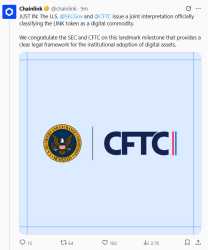
On March 17, 2026, the U.S. Securities and Exchange Commission (SEC) and Commodities and Futures Trading Commission (CFTC) issued a joint interpretation ruling that Chainlink’s LINK token is a “digital commodity” rather than a security. The decision, issued under Section 3(b)(2) of the Commodity Exchange Act, formally removes LINK from the SEC’s securities jurisdiction, a move that had been speculated for months as both agencies grappled with the legal identity of crypto assets.
This classification reflects a broader struggle to enforce the 1933 Securities Act and CFTC statutory boundaries in a world of smart contracts. For years, the SEC’s chair, Gary Gensler, and the CFTC’s chair, Caroline Pham, engaged in public debates about whether stablecoins, wrapped tokens, or oracle networks like Chainlink fell under securities law. This 2026 framework—a narrow, test-case victory for industry—serves as a regulatory compromise. The agencies agree that digital commodities must be treated like oil or gold, sidestepping the “Howey Test” that previously trapped most crypto projects.
The joint interpretation does not settle all disputes. While the SEC disclaims authority over LINK, the CFTC’s enforcement wing will now oversee derivatives tied to LINK and similar tokens. This bifurcation leaves unanswered who regulates tokens issued via airdrops, forks, or DeFi protocols lacking identifiable promoters. The 4chan post omitting such nuance suggests industry advocacy has prioritized precedent over thoroughness.
For investors, this ruling creates a double-edged sword. Chainlink (which holds a non-trivial stake in LINK) may now access traditional finance tools, including futures exchanges and custodial services. Conversely, smaller protocols lacking Chainlink’s legal firepower now face an uneven playing field, as the SEC-CFTC division lacks clear criteria for future classifications.
The coverage lacks critical context on enforcement. Will the CFTC, which historically handles futures and commodities, have the bandwidth to monitor decentralized, cross-border trading of tokens like SOL or BTC? No stakeholder—neither crypto exchanges nor legal scholars—was quoted in this one-sentence 4chan report, leaving unanswered whether the decision is a “victory” or a “bandaid.”
Next steps include the December 2026 SEC rulemaking on crypto asset definitions and potential CFTC guidance for spot market clearinghouses. Markets will test this framework during the October Bitcoin ETF decision, where regulatory alignment or disarray will determine outcomes.