
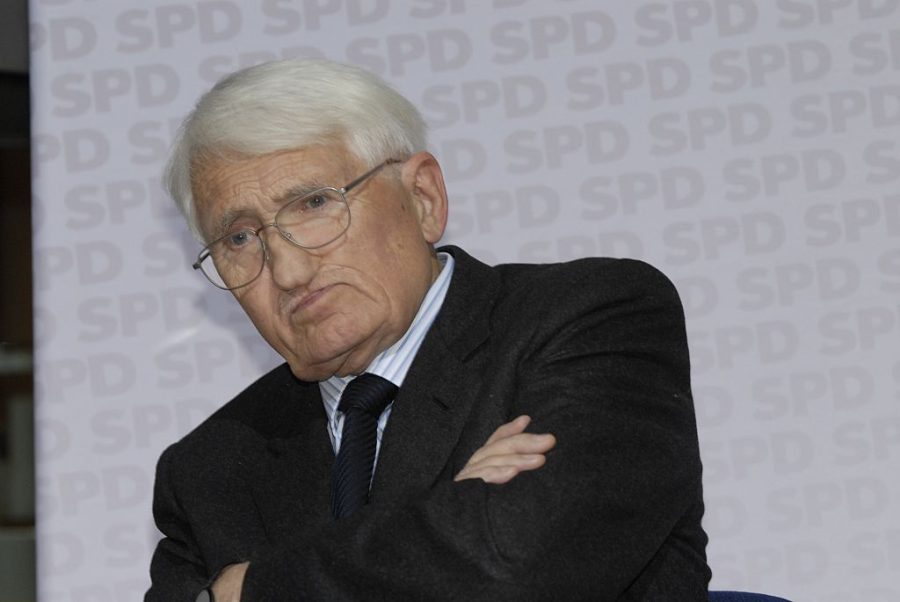
Jürgen Habermas, the German philosopher whose work defined critical theory for generations, died on March 14 at 96. His death marks the end of an era in left intellectualism, with Jacobin and New Statesman framing his oeuvre as both a guide to defeating oppression and a mirror reflecting philosophy’s limitations in the face of authoritarianism.
Habermas’s magnum opus, *The Structural Transformation of the Public Sphere* (1989), remains foundational to understanding how democratic deliberation emerged from 18th-century salons and coffeehouses. New Statesman highlights his prescience: social media’s erosion of deliberative norms today validates his warnings about “illiberal” threats to rational-critical discussion. Yet Jacobin underlines a paradox: a life spent critiquing irrationality concluded with a 2020s-era controversy, where Habermas faced accusations of downplaying Israeli violence in Gaza while retaining sharp skepticism toward U.S. empire. This duality—philosopher as both systemic critic and imperfect human—exposes the limits of abstract ethics confronting geopolitics.
The cross-source synthesis reveals a split in how his work is remembered. New Statesman positions Habermas as a defender of “wild” public discourse, advocating for anarchic debate spaces to pressure formal political institutions. Jacobin, by contrast, emphasizes his later struggles to reconcile Critical Theory with capitalism and his fraught legacy among leftists who saw his rationalism as an elitist dodge. These differing narratives reflect the broader rift between structuralists (who see systems as transcending individuals) and activists (who demand moral clarity).
Habermas’s insistence on “ideal speech situations” invited charges of naiveté—from Gilles Deleuze’s sneer about a “bureaucrat of pure reason” to critiques from Global South scholars who questioned his Eurocentrism. Yet his framework for legitimacy—decisions require consensus among all stakeholders—remains a touchstone in international law and corporate governance. A smart reader would note how his late-career focus on Europe’s “constitutional dilemmas” mirrored the continent’s struggle to balance integration with national identities, a challenge still unresolved.
The most glaring absence in this coverage is concrete analysis of his final writings on AI and algorithmic governance. Neither Jacobin nor New Statesman engages with his 2024 essay *Reason in the Digital Age*, which warned that automated systems could collapse the public sphere by privileging attention over deliberation. Meanwhile, the Gaza controversy remains under-explained: Jacobin describes his soft critique of Israel but omits direct context, like his 2020 lectures on Jewish-German reconciliation, which contextualize his cautious language.
What comes next is less about Habermas the theorist than Habermas the case study. Watch for two battles: a New Left re-examining his work through intersectional lenses, and a neoliberal camp repackaging his consensus model as a tool for corporate ESG. His archives at the Frankfurt Institute will be a battleground; his handwritten notes on late 19th-century labor movements could redefine the history of class politics.